A hardened browser with the blocking built in.
A Chromium fork for Mac, Windows and Linux. Ad and tracker blocking and threat checks are part of the browser itself, not extensions. It has no Google services, and its Ask box tells you where your question goes before you send it.
- per blocking decision, on an M5 Pro
- 2.7 µs
- per blocking decision, on an M5 Pro
- filter-list lines, loaded in 53 ms
- 172,000
- filter-list lines, loaded in 53 ms
- companies the login guard knows
- ~75
- companies the login guard knows
- tests on the Rust components
- 121
- tests on the Rust components
Where it stands
It is being built now. Here is exactly how far along.
There is no download and no release date yet. Everything under "Works today" runs in the current build and is covered by its tests.
Works today
- The browser builds and runs on a Mac as a developer build, on Chromium 157.
- Shields blocks ads and trackers in the network stack, and strips click IDs from addresses before any server sees them.
- Sentinel warns on look-alike addresses, holds disguised downloads, and stops fake login and checkout pages.
- The Ask box answers on the new tab page, in a side panel and from the address bar.
- The main page shows news, weather and markets, with no ads and nothing sponsored.
- Hardened defaults are on, and the Google account, sync and services are out of Settings.
Still to come
- A signed and notarized release for Mac, then Windows and Linux.
- Updates from Aris servers.
- Its own icon and logo.
- A Shields button in the toolbar with the count for the page in front.
- Warnings for known phishing and malware sites. Today it checks how an address and a page look, not a list of bad sites.
- Asking with your own Claude or ChatGPT sign-in, and later with a model on your own computer.
- A side panel that sends a page, a selection or a console error to Aris Code.
Aris Shields
Blocking that no extension rule can switch off.
Shields is written in Rust and runs inside the browser's network stack. Every request a page makes is checked before it leaves, and requests wait for the filter lists at startup, so nothing slips out first.
Ads and trackers
Blocked in the network stack, with the boxes they leave behind hidden too. It is not an extension, so no change to an extension API can weaken it.
Click IDs stripped
fbclid, gclid and the rest are removed from an address before anything is sent, so the site never learns which ad or post you came from.
Three levels per site
Off, standard or strict. Strict blocks every third-party script on the site.
Fast enough to forget
With the six default lists (172,000 lines) it loads in 53 ms and decides in 2.7 microseconds a request, measured on an M5 Pro.
Aris Sentinel, in the browser
It checks where you are before you type a password.
Sentinel's checks run on your computer and send nothing anywhere.
Look-alike addresses
An address built to pass for another site, like paypal.com@evil.test or one using letters from another alphabet, gets a warning before the tab opens it.
Disguised downloads
A file named to pass for a document, like Invoice.pdf.exe, is held as dangerous until you choose to keep it.
Login and checkout guard
A page that asks for a password or a card number under a company's name, on a site that is not the company's, is replaced by a warning naming both. About 75 companies are known so far.
The Ask box
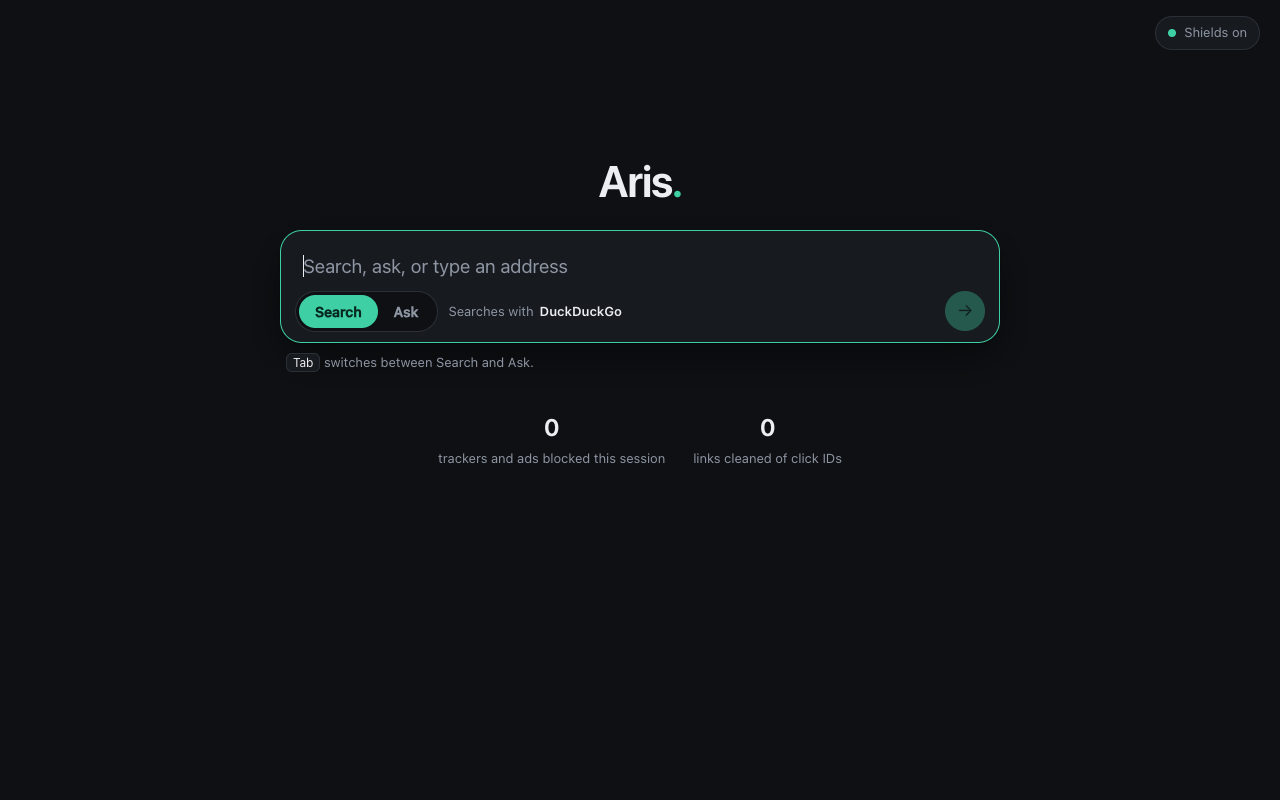
One box: an address, a search, or a question.
The same box sits on the new tab page, in a side panel beside the page, and behind the address bar. A switch chooses Search or Ask, so it never guesses.
It says where your words go
A line under the box names where the text is headed before you send it: your search engine, or Aris.
The page is yours to share
"Include this page" is off until you turn it on. When it is on, the browser reads the page's text and passes it to the model fenced as untrusted content.
It reads. It does not act.
It answers and summarizes. It does not click, type or submit anything on a page.
Chats stay on your computer
Earlier conversations are kept on your computer only, encrypted, and you can delete one or all of them.
Pay for what you ask
It runs on Aris credits with Claude Haiku 5.5, and each answer shows what it cost and your new balance.
Not in private windows
The side panel and the address bar's Ask suggestion are not offered in private windows.
Hardened from the first launch
The safe settings are the starting settings.
- JavaScript's optimizing compilers are off, except on sites you choose to trust. Pages still run; heavy web apps are slower until trusted.
- HTTPS only, with a warning page before a site that has none.
- Third-party cookies blocked, link pings off, no preloading, and Do Not Track on.
- Chromium's ad platform is off: topics, on-device auctions and ad measurement.
- Every one of these is a default you can see and change in Settings.
No Google services
What the browser contacts is measured, not guessed.
An audit script leaves a fresh browser alone and lists every server it talks to. That is how each Google contact was found and cut.
- DuckDuckGo is the default search engine. Google stays in the list for anyone who picks it.
- Settings has no Google account, no sync and no "AI in Chrome" sections.
- The browser no longer asks Google for the time or reports the forms on every page to Google's autofill server.
- One Google contact is left on purpose: the component updater, because it also delivers the certificate lists. It goes once Aris servers deliver them.
The main page
News without the junk.
A new tab is not blank. It is a page of news you chose, with a weather card and a markets card.
News from the publishers
Stories come from each publisher's own feed, with pictures and no ads. It starts with World, Security and hacking, Tech and Sports; you add or remove topics, or paste any site's feed.
Weather that keeps your ZIP
The forecast is from the U.S. National Weather Service. Your ZIP code is turned into a place on your computer and is never sent.
Markets, priced by Ace
A watchlist of stocks, funds, metals, currencies and coins, added by ticker or found by name. No sign-up needed.
In the suite
How it meets the rest.
- Aris SentinelSentinel's address, download and login checks run inside the browser.
- AceThe markets card on the main page is priced by Ace.
- Aris Knowledge GraphThe same Aris account and credit balance pay for the Ask box.
- Aris CodeThe browser detects a running Aris Code. Sending it pages and console errors comes next.planned
- Aris MailA link clicked in Aris Mail opens here already checked.planned
Aris Browser is built on the Chromium project, and the credit to its authors stays in the browser.
The Orb knows this one
Ask about Aris Browser out loud.
AI Kenny knows everything on this page and the rest of the suite. Talk or type; it answers either way.
The rest of the suite
Keep going.
Aris Mail
A mail client that opens strangers as plain text and never lets a message load or run anything.
Native Mac app first · Windows and Linux after
Aris
One voice assistant, the same character on a phone, a speaker and the web.
iPhone · Android · Raspberry Pi
Aris Knowledge Graph
15M+ security concepts, refreshed daily, for any coding agent.
From 1¢ a call · no subscription
Aris Code
The desktop coding agent with the knowledge graph built into every provider.
Free · Mac and Windows
Aris Server + Aris 3.8-27B
An open coding-agent model and the server that runs it on your Mac.
Open source · Apple Silicon
Aris Sentinel
Runtime defense for servers that catches AI attackers by their own narration.
Open source · servers
Quarry
My vulnerability pipeline. It writes its own fuzzing harness and re-found a real CVE in under three seconds.
My own tooling
Ace
Pro charting for crypto in your browser, with the Pine scripts you already use.
$29.99 a month · 7 days free
Ace Wallet
A self-custody crypto wallet for your Mac, with an assistant that drafts and never signs.
Mac first